
Yorkley Village Garden
Our Community Climate Change Adviser, Katie visited Yorkley Village Garden and spoke with Marion Stainton, one of the garden's six committee members.
Yorkley Village Garden began as a community-led idea sparked by two parish councillors, Alison Bruce and Jackie Dale. Building on the success of an earlier initiative, Village Veg, which supported residents to grow food at home through raised beds funded by West Dean Parish Council, they noticed a shift following the Covid pandemic. As daily routines resumed and people returned to work, many no longer had the time to maintain their home-growing spaces.
Seeing both the continued enthusiasm for local food growing and the challenges of sustaining it individually, Alison and Jackie began exploring whether a shared community garden might offer a more resilient solution, one where work, knowledge and harvests could be shared.
When Forestry England offered land in Yorkley, the idea began to take shape. Before moving forward, they surveyed every household in the village and held a public meeting to understand local interest and potential involvement. The response was overwhelmingly supportive, with residents expressing enthusiasm for a Community Garden and several signing up to help bring it to life.
From this strong foundation of local backing, Yorkley Village Garden was born!
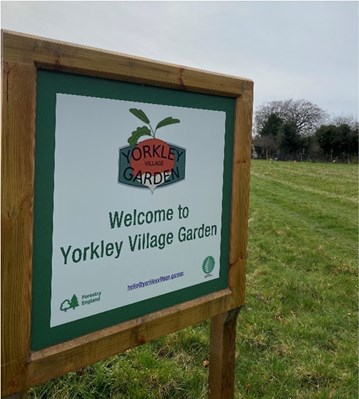

I visited Yorkley Village Garden during a welcome break in the never-ending February rain and was met by one of the group’s six committee members, Marion, whose passion for soil health, surplus sharing and supporting wildlife was immediately contagious. Her four-legged companion Lily in tow, we walked the well-managed one-acre site, once just a field, and Marion explained how in three years, residents have carefully shaped it into a productive and wildlife-friendly community space.
Marion: Yorkley Village Garden is a one-acre plot in the centre of Yorkley. We're right next to the community centre and near the doctor's surgery.
We are a no-dig organic group tending to four annual veg beds, soft fruit bushes, fruit trees, a wildflower meadow with native shrubs and a new polytunnel (which will mean a longer growing season and protection while its still cold) with three raised beds under construction.
We try and work with nature, so very wildlife friendly, and we're a friendly group ourselves!
We welcome anybody who'd like to come and join us. We usually meet on the first and third Sundays of the month, weather permitting, although once the polytunnel's up, that may not be so important.
What do you hope to achieve this summer and over the upcoming growing season?
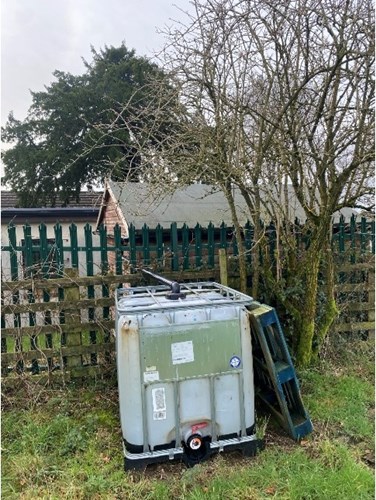
Marion: We hope the polytunnel will have its raised beds in the next, well, hopefully few weeks, at which point we then want to get those up and running and planted. We have a new watering system for the raised beds, which is solar powered (this will be connected to large water storage containers (IBC’s) which collect 6000 litres of water off the roofs on site, as there is no mains water supply).
Some of you may remember last year, we had free food available throughout the summer- extra crops that our volunteers couldn’t use, which we wanted to distribute locally.
I hope there'll be more of that this year and perhaps for a longer season once we've got the polytunnel up and running; producing not only summer crops but hopefully crops longer into the winter season because of the shelter it provides. We could do without the heat of last summer or the wet of the previous summer - something more balanced would be nice!
And we want to get our veg beds fenced against rabbits. That's another project for this year. So we don't lose anything to the bunnies as much as we want to work with nature, perhaps not that closely! …I'm Mr. McGregor!
Can you tell us some of the things that you are doing for nature on the site?
Marion: We have a dead hedge, which uses the clippings from the surrounding hedges and should provide a home for some of the creatures in the garden.
We do sometimes see a slow worm, and we have a visiting toad, so we have some interesting wildlife in the garden. We're going to put a piece of corrugated metal down somewhere in a quiet corner in the hope that we'll encourage the slow worms to nest.
But there could easily be slow worms in our compost heap and various other things nesting in there. So when we do dig that out, we'll have to do it carefully because we don't want to harm anything that might have found a winter home in there.
The local children from Yorkley Village School also built some bug houses for us, which we have around the garden as well. There are three of them to provide additional habitats for local wildlife.
We garden organically, so we use no chemicals or fertilisers. And our compost is no-dig as well. (looking after the soil and using nature's resources kindly regenerates the nutrients for the plants to use and sustains not just the creatures that live above ground, but also those that live below ground, which we tend to forget about because you can't see them.) Other than the mole who's digging under the bench at the moment - it's going to unearth our bench if we don't watch it!
Dean Meadows surveyed the wildflower meadow that we've got, and we have a list of what they found. At some point, it would be nice to get it surveyed again and see whether that has improved with time.
How do you hope things will continue with Yorkley Village Garden over the next couple of years?
Marion: We'd like to see perhaps more local people come and volunteer with us. The upside for them is they get first choice of all the harvests that we have, which is significant. And we'd like to be able to make sure we are sharing more with the community!
Not just this beautiful spot and what we have to offer here, but also the produce that we have from it. The fruit and vegetables are going to just keep getting more as the garden gets more established!